Ontario’s mobile food industry offers high-margin opportunities for new culinary ventures. Knowing how to start a food truck business in Ontario means working through provincial regulations and city bylaws in the right order. Skipping critical steps in licensing or health inspections leads to costly vehicle retrofits and launch delays. Defining a target operating city early prevents major capital losses on non-compliant trucks. Clear planning streamlines everything from legal business setup to final municipal approvals.
This guide provides an explanation of how to start a food truck in Ontario, with the exact cost estimates, up-to-date regulations for 2026, and operational peculiarities of mobile kitchens.
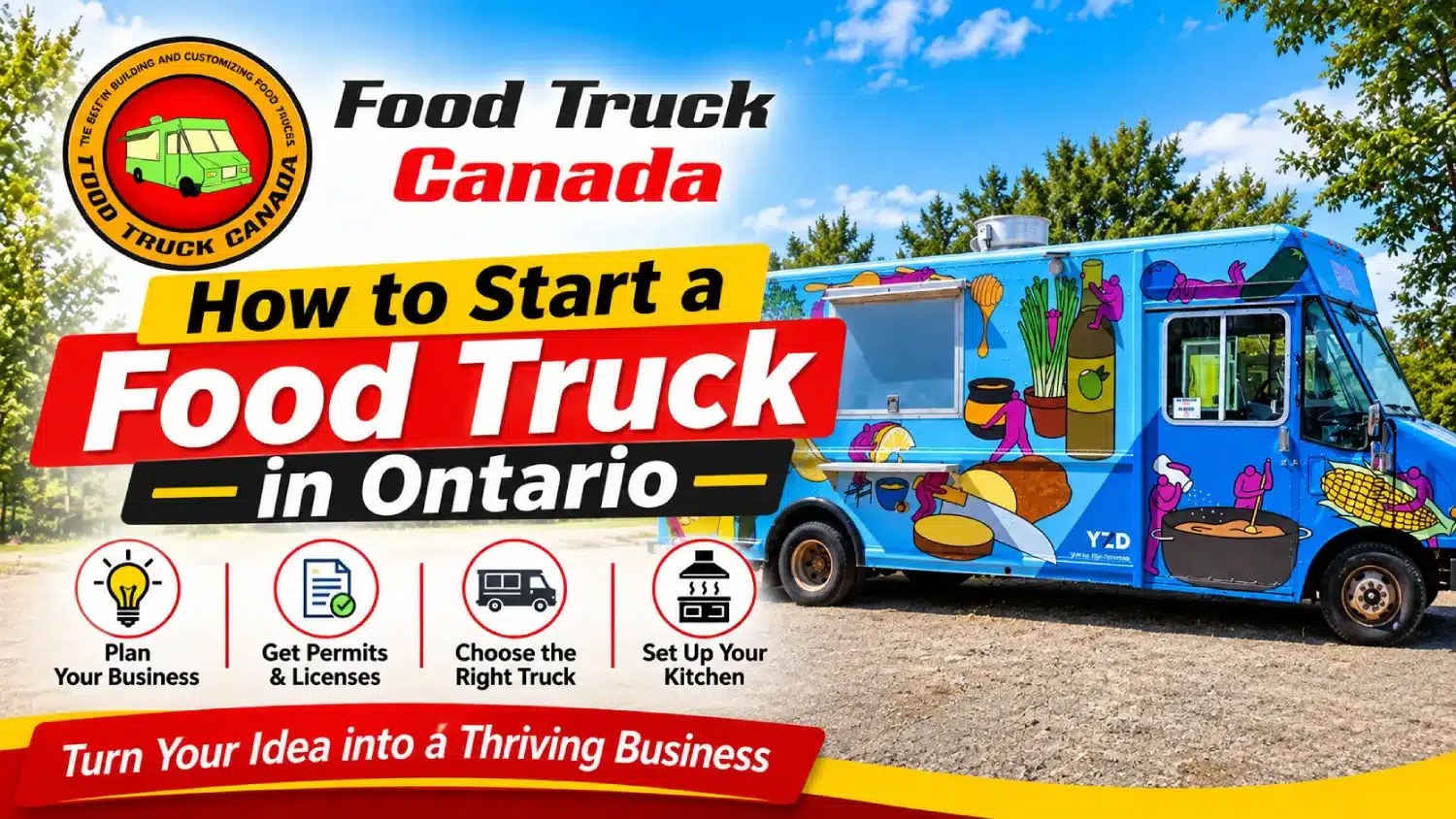
How to Start a Food Truck in Ontario: The 5 Steps
A food truck launch in Ontario requires a business plan, provincial and federal registration, public health approval, insurance, a municipal licence, and a compliant vehicle. The laws vary according to different cities. It takes three to six months for the procedures.
The core sequence is:
-
Build Concept & Financial Model
-
Register Business & Tax Accounts
-
Secure Vehicle & Pass Technical Inspections
-
Obtain Public Health Approval
-
Secure CGL Insurance & Apply for Municipal Permits
How Is a Food Truck Concept and Business Plan Developed?
A strong concept combines a focused menu with fast service, healthy margins, and a memorable brand. Your business plan converts that concept into clear figures: startup costs, target markets, and financial projections. Testing your menu at local pop-ups validates demand before you commit major capital.
Define your niche early:-
High-margin and fast-service menus perform best inside compact food truck kitchens. Tacos, smash burgers, and specialty items are proven examples. Keeping your menu tightly focused on five to eight items reduces food waste, speeds up service, and simplifies your public health review.
Write the business plan:-
The plan should outline:
- Startup costs and equipment budget
- Target markets, including lunch rushes, farmers’ markets, private catering, and festivals
- Pricing, food cost targets, and break-even analysis
- Financial projections for the first 12 months
According to Square Canada, the cost of starting a food truck business in Canada varies from $30,000 to more than $200,000 CAD. The former figure relates to used or leased trucks, whereas the latter represents the cost of custom-made trucks.
Test your market before launch:-
Pop-up events and local recipe tastings deliver genuine customer feedback at low financial risk. Testing two or three signature items prior to launch highlights top sellers early and streamlines kitchen preparation time. This practice also cuts down preparation times once your food truck opens full-time.
How to Register a Food Truck in Ontario
Registration is the first legal step in how to start a food truck business in Ontario. Complete these steps in sequence before applying for municipal licenses:
1. Choose Your Legal Structure
| Structure | Key Feature | Best For |
| Sole Proprietorship | Simple, low-cost setup | Single-owner, low-risk startups |
| Partnership | Shared ownership and costs | Two or more co-founders |
| Corporation | Separate legal entity with liability protection | Growth-focused or multi-truck operations |
2. Register Your Business Name
- Select a unique name for your food truck.
- File your registration online through the provincial portal to secure your Master Business Licence or Articles of Incorporation.
- Keep a digital copy of this filing. Municipalities require this proof before processing any mobile vending licence.
3. Obtain a Federal Business Number
- Apply for a 9-digit Business Number online.
- This number identifies your business and serves as the anchor for corporate tax, payroll, and GST/HST accounts.
4. Manage GST/HST Registration
- Small Supplier Rule: You do not need to collect GST/HST while your taxable revenue stays at or below $30,000 across four consecutive calendar quarters.
- Mandatory Registration: Once your sales exceed $30,000 within a single quarter or over four consecutive quarters, you must register within 29 days of the sale that pushed you over the limit.
- Voluntary Registration: You can choose to register right away. Registering early allows you to claim Input Tax Credits (ITCs) to recover the sales tax paid on your truck build, appliances, and startup supplies.
5. Prepare City Clearance Documents
- Cities require official proof of your legal setup during your vending application.
- Have your business registration papers, business tax number, and any corporate ownership details ready to upload for municipal review.
What Health and Safety Standards Apply to Ontario Food Trucks?
Any plan for how to start a food truck in Ontario has to include provincial health codes and technical safety inspections before receiving a municipal licence.
-
Public Health Clearance:
Submit your kitchen scale drawings and full menu to your local public health unit (e.g., Toronto Public Health, Peel Public Health). The truck must have a dedicated handwashing sink and potable hot water, and pass an on-site inspection.
-
Certified Food Handlers:
Ontario regulations require at least one certified food handler on duty whenever hazardous food is prepared or served.
-
Propane and Fuel Safety (TSSA):
If your equipment uses propane or natural gas, an annual inspection by a Technical Standards and Safety Authority (TSSA) certified technician is required.
-
Vehicle Safety Certificate:
You must obtain a Safety Standards Certificate from an approved Ministry of Transportation (MTO) inspection station. Toronto and Hamilton require certificates issued within 36 days of application, while Mississauga accepts MTO reports within 60 days.
What Insurance and Municipal Licences Does a Food Truck Need Across Ontario?
There is a food truck licence that is issued by each city in Ontario, including their respective fees, insurance requirements, and locations. Cities like Toronto, Ottawa, Mississauga, and Hamilton require at least $2,000,000 liability insurance cover. Anyone planning on operating in different cities will need to register in each city.
Licensing and fees
| Toronto | Ottawa | Mississauga | Hamilton | London | |
| Licence type | Motorized refreshment vehicle owner licence, plus mobile food vending permit for street vending | Mobile refreshment vehicle licence, plus designated space permit for roadway vending | Refreshment vehicle owner’s licence | Food service vehicle Class B licence (travelling food trucks) | Refreshment vehicle licence, Class 1, 2, or 3 |
| Licence cost (CAD) | $1,464.14 (application plus licence); $973.91 renewal | Set in the licensing by-law fee schedule; confirm with the City | $329.77; $319.93 renewal | $648.00 new; $561.99 renewal | $256 (Class 1 and 2); $512 (Class 3) |
| Street vending permit | $3,896.58 (6 months) to $7,793.15 (12 months), HST included | Designated space permit required for roadway licences | Pilot program allows approved parks and on-street areas without a permit | Confirm with Hamilton Licensing | Class 2 covers a sidewalk or location allocated by the City |
| Liability insurance | $2,000,000 CGL | $2,000,000 CGL, City named as additional insured | $2,000,000, endorsed to the City | $2,000,000 motor vehicle third-party and $2,000,000 liability | Confirm with London Licensing |
| Health approval | Toronto Public Health inspection letter | Medical Officer of Health report | Region of Peel health clearance | Hamilton Public Health inspection | Middlesex-London Health Unit |
| Licence term | Renews annually | Annual licences run May 15 to May 14 | Expires April 30 each year | Renews annually | Expires March 31 each year |
Location and operating rules
| Key Rules | |
| Toronto | 30 metres from an open restaurant on public roads; maximum two trucks per block; 12 hours at a time; Gould Street closed to food trucks |
| Ottawa | 46 metres from a food premises unless the business provides a written no-objection letter; not in a residential zone; 9 metres from an intersection; 10 metres from a bus stop; 91 metres from public markets; street sales between 5:30 a.m. and 11:00 p.m.; vehicle limit of 10 by 2.6 by 4.3 metres; external generators prohibited |
| Mississauga | Operation in approved parks and on-street parking areas under a pilot program, reported as extended to April 30, 2027; outside parks, written property owner consent and a site plan are required |
| Hamilton | Written permission of the property owner, a menu, a spill containment plan, and a “Watch for Children” sign for Class B vehicles |
| London | Class 1 operates from one approved private property; Class 3 moves between public or private locations; zoning approval required before licensing |
Note: Regulations and fees change. Verify current details with the relevant municipal licensing office before applying.
How Can I Open a Food Truck Business: Buy, Lease or Rent?
Owning a food truck, whether new or secondhand, gives you the advantage of total control over its interior design. Leasing reduces the burden of initial payment but usually costs more overall than buying. Renting is best suited for test runs and short-term operations. Regardless of your decision, the kitchen needs to conform to public health guidelines such as the installation of a hand washing sink, commercial cooling system, and non-porous surfaces. Size restrictions for vehicles should be known before purchasing a food truck.
How Much Does It Cost to Start a Food Truck in Ontario?
Launching a food truck in Canada can cost between $30,000 and up to $200,000, according to Square Canada. The lower figure applies to second-hand and leased food trucks, whereas the upper figure applies to customized food trucks. A common question is: How can I open a food truck business on a limited budget? The usual answer is a second-hand truck , lease one, or rent a food truck, with some modifications. If we look at Toronto, then just the license and a permit to operate in the streets for six months will cost you $5,300. You will need to add propane, commissary fees, inventory, brand and labor costs, with an additional 15% for repairs.
How Profitable Is a Food Truck in Ontario?
How can I open a food truck business that actually makes money? Food trucks can make profits in Ontario, but success will greatly depend on how efficiently the business is managed. From the information provided by Toast Canada, Toronto food trucks make approximately $150,000 to $250,000 per year, although a large portion of the revenue goes towards paying for food, labor, and overhead costs. Profits can be made from an efficient menu, good lunch and events venues, and catering services.
Where and How Do Food Trucks Find Customers in Ontario?
Once you know how to start a food truck in Ontario, the next question is where to sell. Effective operators combine approved vending spots with local marketing initiatives. Office parks, breweries, festivals, parks, and private events provide consistent demand. Events can have special licensing requirements, including a $63.59 per vendor fee in Mississauga. Start marketing your vending operation four to six weeks prior to launch: set up your Google Business Profile, post a weekly schedule of your spots, get customer reviews, team up with local businesses, and offer catering services. Your business might need a commissary kitchen based on the public health unit.
How to Start a Food Truck in Ontario With Food Truck Canada?
Opening a food truck in Ontario can be accomplished through the following five steps: plan, register, obtain a food truck that complies, pass the public health inspection and finally get licensed and insured. Once the steps are clear, the next thing that one needs to do is complete the financial projection and the zoning bylaw check and begin the public health plan review process. Before purchasing any equipment, ensure that the municipal and insurance requirements are satisfied since this is what will prevent costly retrofitting and delays. Food Truck Canada has been designing custom food trucks for 18 years according to your cuisine, brand and business requirements.
Schedule a free consultation now.